
How to Turn University Reporting into a Value-Building Strategy

In many academic institutions, external communication still resembles a chronicle of events.
“A meeting was held…”, “An agreement was signed with…”, “A delegation visited the university…”, “New equipment was purchased…”.
Such announcements may be formally correct, but they rarely generate interest, engagement, or a sense of value for the audience.
Universities often fall into the trap of reporting their own activities. Yet the attention of students, prospective students, researchers, and industry partners has become one of the most valuable resources today. Audiences are not looking for information about administrative processes themselves. They want to understand what those developments mean for their studies, research, careers, or professional opportunities.
Effective communication should not stop at answering the question, “What did we do?” Instead, it should explain “What does this change?”
The “So What?” Test: The Most Important Communication Filter
Before publishing any announcement, it is worth asking one simple but demanding question:
So what?
The question is not whether the information is important to university leadership, a faculty, or an administrative unit. The question is whether it matters to the audience.
If you cannot explain in a single sentence why a student, doctoral candidate, researcher, or business partner should spend time reading a message, you are probably describing an event rather than its significance.
This is where strategic communication truly begins.
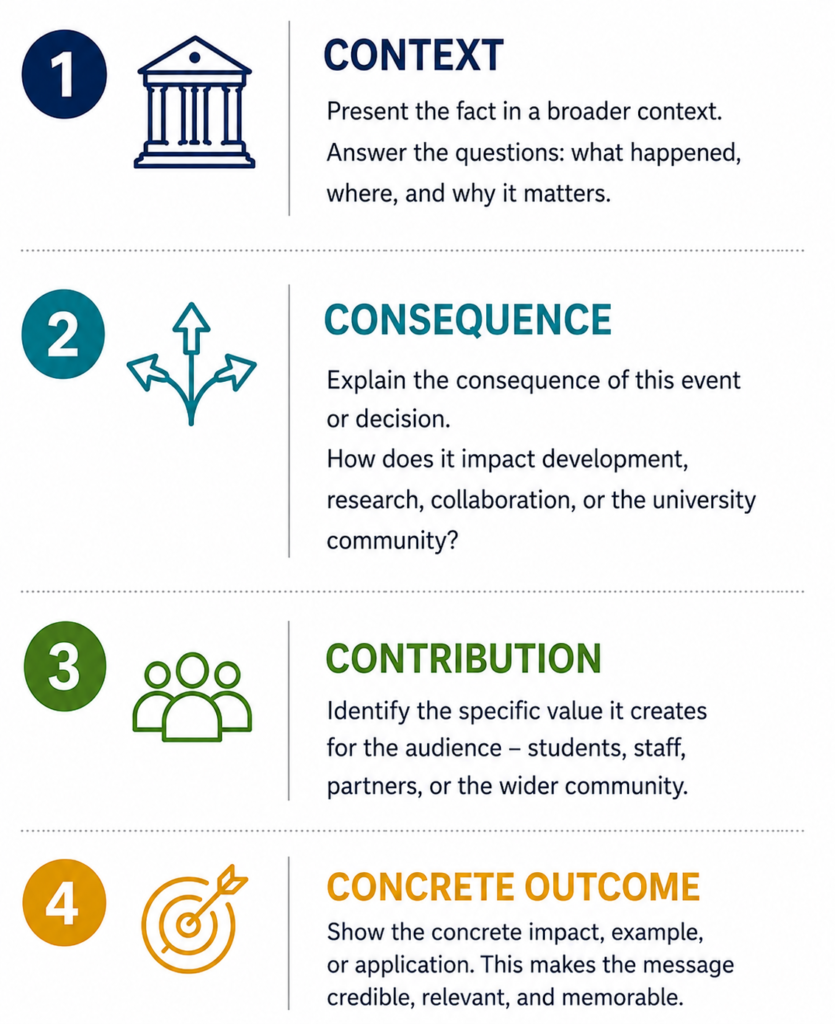
The 4C Framework: From Message to Value
To avoid the trap of chronicle-style communication, it is useful to apply a simple four-step model.
1. Context
What happened?
This is the factual level.
Example:
The university signed a partnership agreement with a technology company.
2. Consequence
So what?
What will actually change as a result of this action?
Example:
Through this partnership, students will gain access to new technologies and projects developed together with an industry partner.
3. Contribution
What value does the audience receive as a result?
How does this development contribute to the growth, opportunities, or success of students, researchers, or partners?
Example:
Students will develop practical skills and industry-relevant experience that strengthen their future career prospects.
4. Concrete Outcome
How will it affect studies, research, or careers in practice?
What specific change will people see, experience, or be able to use?
Example:
Starting next semester, selected courses will incorporate tools and solutions currently used in the technology sector.
If a message does not pass through all four stages, it will usually remain nothing more than information about institutional activity.
From Reporting to Value-Based Communication
The examples below illustrate the difference between activity-focused reporting and communication that highlights value for the audience.
| Area | Reporting Model | Value-Based Communication |
|---|---|---|
| Strategic Partnerships | The university signed an agreement with a technology company. | Through this partnership, students will gain access to skills, tools, and experiences used by industry leaders. |
| Research Infrastructure | Research equipment worth €X was purchased for the faculty. | The new equipment will enable internationally competitive research and support more advanced student and faculty projects. |
| Organizational Decisions | University leadership met with student representatives. | The proposed solutions aim to provide greater flexibility in the student experience and better respond to student needs. |
| Academic Conferences | An academic conference was held on June 20–22. | The conference brought together experts to discuss trends that are likely to shape the future of the discipline in the years ahead. |
In each case, the event itself remains important. What changes is the focus of the message. Instead of describing institutional activity, the communication explains why that activity matters.
Why Does This Approach Work?
Value-based communication changes how audiences perceive a university. Rather than seeing an institution that merely reports its activities, they see an organization actively shaping an environment that supports learning, research, and professional development. Announcements about partnerships, new facilities, or academic events become meaningful only when they explain the outcomes and opportunities they create. People engage not with events themselves, but with their significance.
This approach is also a form of respect for the audience’s time. In an environment saturated with information, attention is drawn not to facts alone, but to their implications. Before publishing a message, it is therefore worth asking whether it answers four essential questions: What happened? Why does it matter? Who does it matter to? What value does it create? What concrete outcome does it produce? If any of these questions remain unanswered, the issue is often not with the audience’s interest, but with the way the message has been framed.